What BMX Core Strength Actually Means
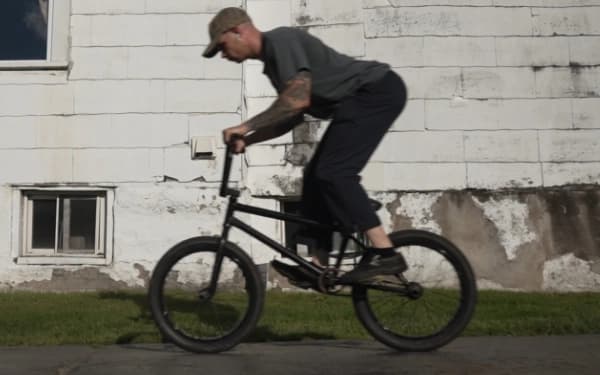
BMX core isn't about visible abs. It's about stability and force transfer. When you land a big jump, your core braces to absorb impact and keep you in control. When you pull a barspin, your core transfers the torque from your hips through your arms. Six-pack exercises train flexion — BMX needs stability and rotation.
Anti-Rotation: The Missing Movement
Pallof press: attach a resistance band to a fixed point at chest height. Stand perpendicular, hold the band with both hands at chest, extend arms straight in front of you and hold for 3 seconds. The band tries to rotate you — your core resists. Three sets of 10 per side. This trains exactly what you need to stay square on the bike through turbulence.
Dead Bug
Lie on your back, arms pointing at the ceiling, knees at 90 degrees. Extend opposite arm and leg toward the floor simultaneously while pressing your lower back flat. Slow and controlled — 3 counts down, hold 1, return. Trains the deep stabilizers that protect your spine on landings. Three sets of 8 per side.
Single-Arm Farmer Carry
Grab a heavy dumbbell or kettlebell in one hand and walk 40–50 meters, keeping your torso perfectly square. The asymmetric load forces your core to resist lateral flexion — exactly what happens when the bike moves under you in the air. Switch hands each set.
Rollout and Plank Variations
Ab wheel rollouts build functional anterior core strength. Start from knees, progress to feet. Plank with alternating arm reaches builds anti-rotation and shoulder stability simultaneously. Both earn their place in a BMX-specific program.
Summary
Train stability, anti-rotation, and force transfer. The riders who stay square on landings and control the bike through the air have it. Build it.